
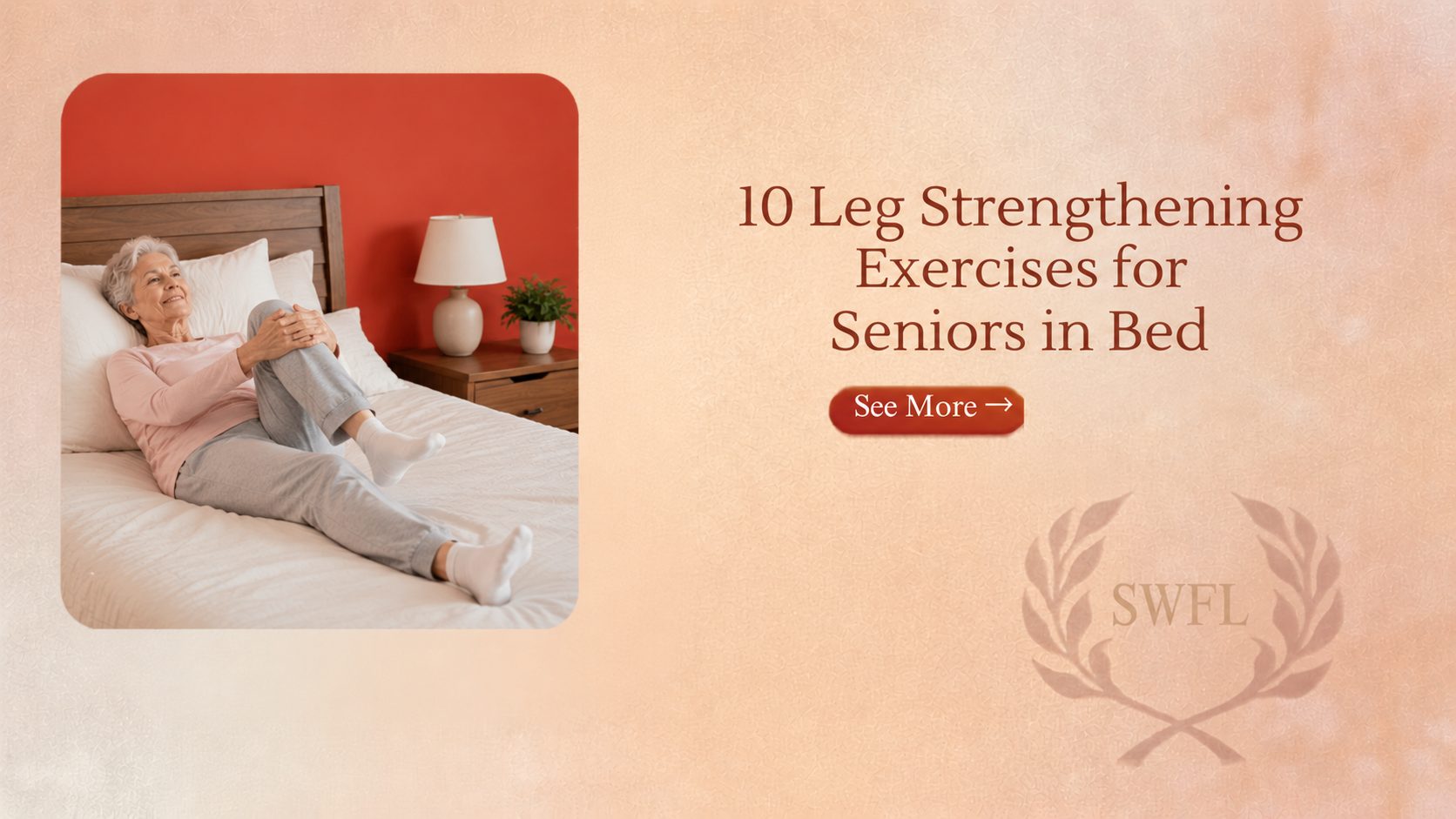
When getting out of bed feels like a workout on its own, the last thing you would probably like to hear is, “You need to exercise more.” However, weaker legs may make basic functions, such as rising from a sitting position, going to the bathroom, or even getting out of bed itself, quite difficult.
You don’t always need to get out of bed to start strengthening your legs. Movements that can be done in the lying position can help elderly people keep their legs active and increase their strength.
Why Leg Strength Matters as You Age
Your legs are not just there to help you walk around your house. Healthy leg muscles are necessary for standing, walking, getting up from bed or a chair, balancing yourself, and completing daily activities without help.
As people age, it is normal for muscle mass and strength to be reduced, especially if there is a lack of physical activity. Prolonged bed rest or being inactive could cause this weakness to become apparent.
Even simple movements can be very helpful in this case.
According to federal physical activity guidelines, leg strengthening exercises for seniors in bed are recommended to be included in the routine of older people, along with aerobic and balance exercises. Also, these guidelines stress the importance of engaging in a physical activity program for older people who are able to.
However, the task here is not to start with intensive exercise immediately after being inactive for a long time. The goal is to move safely, consistently, and gradually.
10 Leg Strengthening Exercises for Seniors in Bed
These bed exercises for legs focus on different muscle groups, including the thighs, hips, calves, ankles, and glutes.
Start slowly. If an exercise causes pain, stop rather than trying to push through it.
- Ankle Pumps
Ankle pumping is one of the easiest bed exercises that can be done by elderly people because it is so simple to do and requires almost no effort at all.
How to do it:
- Lie down on your back in a comfortable position with legs either straight or bent.
- Move your toes forward, away from your body.
- Then move your toes backward towards you.
- Alternate between both movements.
Try to repeat this procedure around 5 to 10 times for each leg.
This exercise will work on your ankle muscles as well as promote regular motion of the feet. According to the NHS guidance on doing bed exercises, ankle dorsiflexion and plantarflexion can be regarded as lower limb exercises.
Do not overextend your ankle joint, as a comfortable range of motion is enough.
- Heel Slides
Heel slides involve gentle movements of the knees and exercise of the legs and are some of the easiest bed exercises for older people to perform.
How to do it:
Lie down flat on your back, keeping both your legs straight.
Gently slide one heel towards your buttocks, bending the knee gently. Then slide the heel away to keep the leg straight.
Perform this with the other leg as well.
Begin with 5 repetitions each for both legs, and can increase slowly if you find it easy.
The exercise will help maintain mobility of the knee and hip joint, along with using the muscles of the leg. The heel slides are often recommended by hospitals as basic bed exercises for rehab.
The important thing is to be careful. Avoid dragging the heel fast or pushing the knee hard.
- Seated or Lying Knee Extensions
If you feel discomfort when lying on your back, this exercise can also be performed while sitting in a supported position on the bed.
To perform this exercise in a lying position, put the pillow or the towel under the knee to keep the leg slightly bent.
Straighten the leg by lifting the lower leg. Hold it for some time and then lower the leg.
Repeat the procedure 5-10 times per leg.
It mainly involves the quadriceps, which are the large muscles located at the front side of the thighs. The main function of these muscles is related to the process of getting up, walking, and knee joint movement.
When lowering the leg is too challenging, decrease the number of repetitions.
- Quad Sets
Want a good workout that needs almost no movement at all? Give quad sets a try.
This is especially helpful for older patients who are not very mobile since they involve squeezing the muscles of the thighs without moving the whole leg.
How to do it:
- Lie down flat on your back with your legs straight out.
- Contract the muscles of the front of one of your thighs.
- Push back the kneecap gently towards the mattress.
- Hold the contraction for about 3 to 5 seconds.
- Release completely.
- Do the same with the other leg.
Start by doing the exercise 5 times with each leg.
Static quadriceps contractions are recommended for bed exercises in NHS rehabilitation facilities, and they are known to help build up strength in the necessary muscles.
Make sure you breathe steadily while contracting the muscle.
- Straight Leg Raises
This is a more difficult exercise and should therefore be done by senior patients who can already move their legs easily.
How to do it:
Lie down on your back with both your legs straight.
Contract the thigh muscles of one leg and, keeping your knee straight, lift the leg a few inches above the mattress.
Pause for a while and then gradually lower the leg.
Alternate legs.
Begin with 3-5 repetitions on each side.
Your legs do not have to be raised very high. Actually, raising them higher will only make this difficult exercise tougher than necessary.
Straight leg raises can be included in clinical bed exercises and may even target the muscles around the knee and hip.
If you are unable to lift the leg, then revert to quad sets or heel slides.
- Side-Lying Leg Lifts
Your legs don’t only need strength for forward movement. Muscles near the hip joint are responsible for side-to-side motion and balance as well.
Leg lifts while lying on your side is an example of an exercise that targets those muscles.
How to do it:
- Lie comfortably on one side.
- Bend your bottom leg slightly for extra balance, if needed.
- Extend the other leg straight.
- Lift the leg off the ground a few inches up slowly.
- Put the leg back down.
- Repeat a few times, and then switch sides.
Start with 5 reps on each side.
If lying on your side is uncomfortable or even dangerous, you should not perform this exercise without professional supervision.
- Hip Abduction
Another beneficial exercise for elderly individuals that can be done with their legs in bed is hip abduction. Lie down flat on your back with your legs straight.
Slowly move one of your legs outwards and keep your feet pointed towards the ceiling, then move the leg back into the center position.
Perform the exercise on the other leg.
Start with 5 repetitions per leg.
This particular exercise works on the muscles on the outer side of your hip and thigh. These muscles work on stability and movement of the legs sideways.
Hip abduction and hip adduction have been mentioned as part of the NHS rehabilitation guidelines for exercises for strength in the lower limbs which can be done in bed.
The range of motion does not have to be great.
- Hip Abduction With a Pillow
Now let’s work the opposite direction.
Put a soft pillow between your knees when lying flat on your back. Slowly press your knees toward the pillow.
Hold the position for 3-5 seconds and then relax.
Do 5 to 10 repetitions.
It is an easy exercise to target the inner thigh muscles without having to make big leg movements.
Make sure the squeeze is gentle, since the idea here is not to crush the pillow but to engage the muscles.
- Glute Squeezes
The glutes are yet another important muscle group that helps you stand up and walk. And you can train them without even moving your legs.
How to do it:
Lie down in a comfortable position.
Contract your buttocks as if you are trying to tighten them together. Hold this position for 3-5 seconds, then release.
Do this 5-10 times.
It may seem incredibly simple, which makes it perfect for the person who has limited ability to move around.
Such exercises as glute squeezes have been recommended by the bed exercise programs of NHS hospitals.
As your strength improves, glute squeezes may be used as a warm-up before other activities.
- Bed Bridges
If the previous exercises are now easy for the senior and if he or she is able to bend his or her knees, the bridge would offer more challenge.
How to do it:
- Lie down flat.
- Bend your knees and rest your feet flat on the mattress.
- Maintain some distance between your feet.
- Engage your abdominal and gluteal muscles.
- Now raise your hips off the mattress.
- Hold it for a few seconds.
- Then slowly lower your hips back down.
Start with 3 to 5 repetitions.
The bridge strengthens the hips, buttocks, and muscles surrounding them. The NHS guidelines recommend that the bridge exercise is one of those bed exercises that strengthen the muscles and relate to activities like getting up from a chair or moving in bed.
If raising your hips proves to be difficult, then avoid it. Instead, try glute squeeze and heel slide first.
A Simple Bed Exercise Routine for Seniors
There is no need to do all 10 exercises during a single workout.
If a person is just beginning to do exercises, shorter workout sessions might be more feasible:
Basic workout:
- Ankle pumps – 10 repetitions
- Heel slides – 5 repetitions per leg
- Quad sets – 5 repetitions per leg
- Hip abduction – 5 repetitions per leg
- Glute squeezes – 5 repetitions
Rest as required between exercises.
When this becomes easier, you may slowly include straight leg lifts or bridges in your routine.
According to NHS advice, gradual increases in repetitions are preferable to a sudden jump into an excessive amount of exercises.
Consistency should take precedence over turning a 10-minute routine into a long session.
How Often Should Seniors Do Bed Exercises?
There isn’t one perfect routine for every older adult.
While one person may need a totally different exercise program due to some illness or surgery, another may need just to be physically active despite good health.
In general, the recommendations are that muscle strengthening exercises must be done at least twice a week, along with other physical activity daily, based on the ability of a person.
Regarding bed exercises, the frequency and amount of repetitions depend on the person’s mobility, strength, medical conditions, and the recommendations of his physician.
The following principle is worth applying:
Small start → regular repetition → gradual increase.
Five controlled repetitions will be more beneficial than 30 repetitions done once and then suffering pain the next day.
How to Make Bed Exercises More Effective
Bed exercises are a beginning, not necessarily an end point.
As mobility increases, gradually add in more difficult exercises, as suggested by your healthcare practitioner.
One may advance from:
Ankle pumps → heel slides → leg lifts → sitting exercises → standing exercises → walking.
It all depends upon the capability of that person.
But once a person gains the ability to leave the bed, some other exercises, like sit-to-stand, calf raises, and balance exercises, could pose further challenges.
Leg strength and balance are especially significant aspects of the prevention of falls among the elderly.
The goal is not to remain bedridden forever.
The goal is to use bed exercises as a means of advancement towards greater mobility and independence.
Safety Tips Before Starting Bed Exercises
Not even light exercises are always safe for everybody.
Before embarking on an exercise program after hospital stay, surgery, injury, stroke, or any other major change in your health state, you should consult a doctor or physical therapist. In addition to the above factors, the NHS advises people to seek professional advice when they have medical issues before doing any exercise.
Keep these basics in mind:
- Move slowly rather than jerkily.
- Maintain normal breathing during each exercise.
- Do not push yourself into pain.
- Use fewer repetitions if there are weak muscles.
- Have your commonly used items within reach in order not to make any strange movements.
- If coordination or balance is poor, have the right caregiver close by during the exercise.
- Do not continue with any exercise that makes you feel pain, dizziness, or excessive shortness of breath,or worsens your condition.
There are some cases where particular exercises might not be suitable after a specific surgery, fracture, stroke, or heart disease.
When Should a Senior Avoid Exercising Alone?
If an older adult has significant weakness, has recently had a fall or an accident, has had surgery, has poor balance, problems with movement control, etc., exercise alone is probably not the best choice.
A professional physical therapist will be able to check your mobility and make a tailor-made plan for you.
It is particularly true for those seniors who spend most of their time in bed. In some cases, the problem may be not only weak muscles but also a medical condition.
The proper exercise is the one that suits the current level of fitness, not the most complicated one.
Can Bed Exercises Replace Walking or Regular Exercise?
Not completely.
Bed exercises can be incredibly helpful for individuals with reduced mobility, but they may not give all the advantages associated with a full physical activity program.
While mobility increases, elderly individuals must try to do some other physical activities which suit their abilities, including strength training, balance training, stretching, and aerobics. According to federal recommendations, these types of physical activity need to be combined for individuals who are physically capable of doing that.
Nevertheless, for those individuals who cannot walk properly, doing something in bed is a much better idea than doing nothing at all.
The Bottom Line
Getting stronger doesn’t always begin with standing up.
For many seniors, the first step might be some ankle pumps, a controlled heel slide, or even contracting the thighs while lying down. Simple movements like these can help keep the legs active and provide a safe start to exercising.
The ideal leg exercises for seniors in bed are those that fit the senior’s capabilities and can be done regularly and without risking injury.
Do some gentle leg exercises in bed, slowly build up strength, and consult a doctor or physiotherapist if there are any mobility problems or health issues.
Sometimes, getting strong comes down to moving each leg at a time.
Important note: The information above is provided for general educational purposes only and is not intended as specific medical advice or treatment.