
Dementia doesn’t happen all at once. It often begins with small, easy-to-miss changes, like forgetting a name or misplacing everyday items, and gradually progresses into a condition that affects every part of daily life.
It may look small, but it is noticeable. For families and caregivers, recognizing these changes early can make a meaningful difference in how they plan, respond, and provide support. For that, you must know about the seven stages of dementia that will help you identify physical changes earlier and plan for what the future holds.
Understanding how dementia develops isn’t just about awareness. It is about making important decisions, such as when is the best time to help prepare for any needed care, and what assistance we can provide to individuals with dementia.
What is Dementia?
It is not just about forgetting things – dementia slowly reshapes thinking ability, recalling, and daily routines. At first, signs hide in plain sight: lost keys, names on pause. As weeks pass, talk changes shape; choices grow harder. Even moods begin to drift. The person stays present – yet somehow different.
Changes in the brain bring dementia, not simply growing older. Often tied to conditions like Alzheimer’s, daily tasks grow tougher over time without proper help. Spotting symptoms sooner helps shape how people react later. Knowing what occurs inside shifts how responses form down the line.
According to clinical frameworks like the Global Deterioration Scale (GDS), dementia progresses through seven distinct stages.
These stages create a road map for healthcare providers to better understand how each of the various symptoms of dementia has changed from normal functioning to very poorly functioning as time passes.
Understanding these symptoms helps caregivers anticipate future needs for the patient with dementia and to make appropriate adjustments to their care plan.
What Are The Stages Of Dementia?
There are seven stages of dementia, depending on how far a person has progressed. The 7 stages are often documented visually using charts. These can help express and clarify the gradual changes that occur when dementia progresses.
There is no one “correct” way to progress through dementia, as each person will progress differently.
Some people may move through stages faster than others, whereas a few may stay in one stage for several years. The key isn’t to track how long someone stays in a stage, but to recognize patterns that signal progression.
7 Stages of Dementia
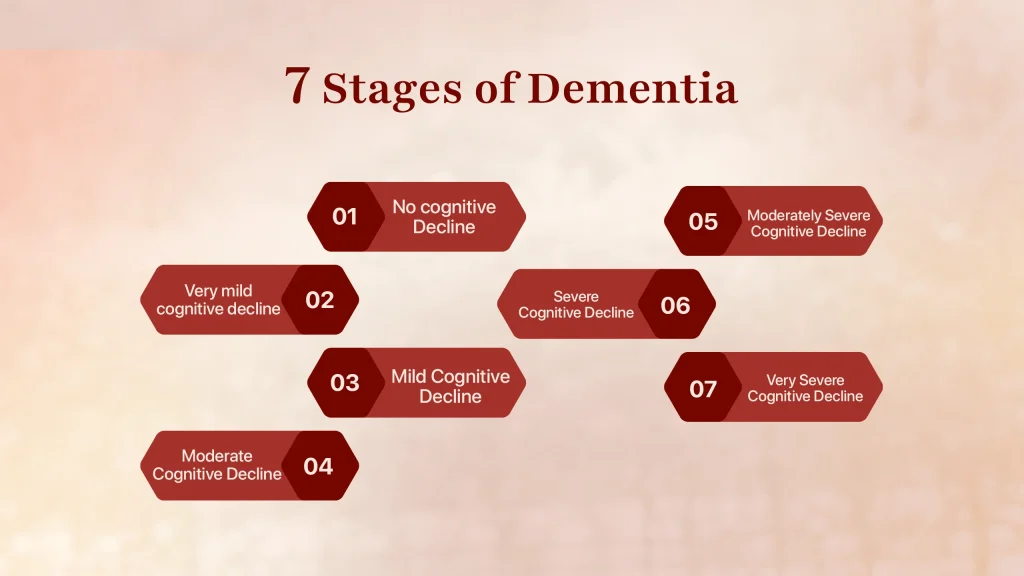
The stages range from no symptoms to severe cognitive decline, from being completely symptom-free to needing full-time assistance due to the loss of cognitive function and the decline of one’s ability to function independently.
The early stages of dementia are usually the mildest and may not significantly disrupt daily life; in contrast, the later stages will often create substantial challenges for both the individual and their family.
By understanding these seven stages of dementia, families can better prepare themselves to handle the impacts of dementia on the individual suffering from dementia.
Families can also ensure that they properly provide the appropriate level of care or assistance to the individual based on their current need level and provide for the continuing needs of the individual over time.
Stage 1 of Dementia: No cognitive decline
In this first stage of dementia, there are no observable signs of dementia. Those individuals will be able to perform all of their normal daily routine, including memory and cognition, and this is considered a typical example of brain health.
During this stage, no signs of dementia are observed on medical examination. Individuals are completely independent and can perform all needed tasks, including working, completing tasks, and socializing independently.
This stage is most common in adults aged 40 to 60. Many seniors may remain in this stage depending on their overall brain health.
This stage would be the baseline to begin measuring the degree of decline throughout dementia’s 7 stages.
Stage 2 of Dementia: Very mild cognitive decline
During this second stage of dementia, individuals experience very minimal changes to their cognitive abilities, which are often thought of as normal changes associated with aging.
At this stage, individuals may occasionally not be able to recall the name of someone they know, lose objects, and struggle to think of a certain word.
These changes happen occasionally for seniors between 50 and 65 years and don’t interfere with daily life. In fact, most individuals, even their immediate family, will not notice these changes that are occurring in the individual, as the changes they are experiencing are typical age-related forgetfulness.
Individuals at this stage remain fully independent, and many people will continue to think that the changes they have experienced are simply a result of having forgotten something, as they would have in previous years.
Stage 3 of Dementia: Mild Cognitive Decline
As Dementia progresses, Stage 3 is when the early signs of dementia become obvious. Mild cognitive impairment (MCI) is the term given to this phase, where dementia is likely suspected for the first time.
Seniors aged around 55-70 may experience difficulty concentrating, organizing, remembering things they recently heard or said, or being able to find a particular word they are trying to say. They may also misplace items more often than before.
Changes are now more apparent to friends, family, and/or coworkers, but the individual is able to live an independent life. At this point, performance at work or on complex tasks may begin to decline.
Stage 4 of Dementia: Moderate Cognitive Decline
Stage 4 is the phase of transition to being an early-stage person with dementia, and now the person has more severe symptoms that impede on their daily lives.
Seniors aged 60 to 75 will experience difficulty managing finances, remembering past events, or completing multi-step tasks, and, as a result, will withdraw from social situations due to frustration or embarrassment.
This stage can be frustrating, as individuals begin to notice their own limitations.
A physician will generally confirm someone has dementia at Stage 4, and typically, a support system will need to be in place to help the individual provide support for complex activities, while they are still able to care for themselves independently.
Stage 5 of Dementia: Moderately Severe Cognitive Decline
At this stage, the need for support becomes more evident. At Stage 5, seniors aged 65-80 start needing help with daily activities as confusion increases compared to earlier stages.
They may struggle to remember recent events or what just happened, and they often forget things that are not in front of them.
Most individuals can still perform basic tasks like eating and using the restroom, but they need guidance and supervision.
Stage 6 of Dementia: Severe Cognitive Decline
Stage 6 is characterized by having significant memory loss and becoming increasingly dependent upon a caregiver for most activities in life. Memory loss becomes severe, and individuals may not recognize close family members.
Major behavioral and personality trait changes will occur at Stage 6 for the seniors aged around 70 to 85. This may include increased anxiety or excessive agitation, such as sleeping habits, nervousness, perhaps aggressive or physical aggression towards themselves or other individuals, etc.
This stage is often emotionally difficult for families, as loved ones may no longer recognize them.
Individuals at Stage 6 will need to have assistance completing basic daily living tasks such as putting on clothing, bathing, or toileting.
Caregiving during this stage will take a significant emotional toll on the individual providing care; thus, support systems such as family involvement, professional caregivers, and structured care environments must be developed immediately.
Stage 7 of Dementia: Very Severe Cognitive Decline
Stage 7 is considered the end of the spectrum in terms of dementia progression. At this point in the individual’s journey through dementia, they are no longer able to communicate verbally and will need around-the-clock assistance.
Speech may be limited to a few words or lost entirely. Physical ability, such as the loss of the ability to walk, sit, and swallow, will have diminished considerably.
At this point, the focus shifts from active care planning to simply providing comfort and quality of life by using appropriate services for the person with dementia, either at home with some assistance or in an appropriate long-term care facility. Seniors aged 80 and above are most likely to be affected by this.
Understanding the 7 Stages of Dementia
Understanding the 7 stages of dementia can help family members better understand their loved one’s journey through the disease. The progression of the disease will differ for each individual; however, there will be many similarities for each family.
Using tools such as the 7 Stages of Alzheimer’s chart and the 7 Stages of Dementia chart can prove to be valuable tools for families during this journey.
These charts take complex symptoms of a person with dementia and put them into an organized system so that family members can identify which stage their loved one is currently in and where their loved one is headed next.
At this point, care focuses more on comfort, dignity, and quality of life.
Identifying the stage of progression can result in improved outcomes. Early intervention can provide for timely medical treatment, improved care planning, and better emotional support for the person with dementia and the caregiver.
Why Awareness of the Stages of Dementia Is Important
Awareness of the various stages of Dementia can greatly help your ability to manage your expectations and provide your loved one with the supportive care they deserve.
Each of these seven different stages of dementia carries its own challenges and continues through to the later stages of dementia, but can also provide an opportunity to enhance your loved one’s quality of life with appropriate care.
Dementia is a journey, not just a health issue, both for the person with dementia and their family. Understanding the various stages of dementia is an important step in traversing that journey with respect and clarity.
Understanding the 7 stages of dementia does not alter a diagnosis, but it does alter how prepared you will be to face it.
By knowing about dementia, families can better prepare to make timely decisions regarding care, obtain the appropriate level of care needed, and ensure their loved one has access to appropriate support that is dignified during each of the stages of the progression of the disease.
When you know what to expect, you have the confidence to respond appropriately, which can help reduce diversion from being on track, and your focus will be on what is truly important. By providing comfort, stability, and quality of life, you are showing your loved one affection.